It's been a while since I've posted! I deeply apologize to anyone still following my blog; if any of you are, or have been, in an interior design curriculum, you know how busy it gets. Combine that with an active life, and things get a little crazy. However, this will not stand: I will be posting more often. I definitely have things to say, things to share!
Speaking of, today I'm sharing a presentation I will be giving today regarding an assignment given for my Studio III class. (The title of the assignment is the title of my post.) What we did was take an ordinary object we interact with daily, and see what we can do to improve upon it when we strip away our usual expectations of that object and see it with new eyes. Well, I smoke: my object was a lighter. I use BIC disposables, mainly because that's what my husband buys. I'd like to take a more eco-friendly stance to things I use and design, and frankly, *everything* can be improved upon (even the most awesome, seemingly perfect products available).
For this class, we are using, and being encouraged to use, sketchbooks: all the images I've created come straight from mine. This is a great opportunity for me to develop my sketching skills, but it also helps me order my thoughts and get them down on paper. If nothing else, perhaps this will encourage anyone seeing my presentation to use their sketchbooks as well without fear.
Monday, September 19, 2011

Saturday, January 22, 2011
A New Quarter at SCAD
I've thought about writing this update before, but hadn't gotten to it until now. It's a Saturday, which for most people may mean "weekend" but for me means time to work on projects and assignments that I can't, for whatever reason, get to during class times. It's also morning, which means coffee for me to wake up my brain. A blog update sometimes helps me ease into a day's work, as well.
A hiccup in class scheduling lead me to a decision I'd been waffling over but finally took took the plunge: I've officially attached Art History as a minor. Therefore, this quarter I'm studying Ancient Art and Architecture, which for this class means Greek and Roman -- we're in the middle of Greek vase painting and the Labors of Herakles. Another component of the class includes a "Lost Art" project and paper, and I've decided to study the Temple of Artemis at Ephesos. What in particular about it I'm not sure of yet; I've just begun my research and will nail it down as I read further. I'm particularly excited about it due to my beliefs (mentioned in my "About" page) - although I adhere more to Celtic and Norse pantheons, the Greek hold some residual appeal since it was reading Greek mythology that began my studies in general. Artemis the huntress has always been a favorite of mine in the Greek pantheon.
Other classes I'm taking this quarter are Electronic Design (which means AutoCAD 2011) and Studio I (which is focused upon residential design). I'm also excited about these classes for many reasons. The former will be a big boost to my resume, and I'm hoping could lead to an internship or part-time job soon. I'm also a technophile, and having another tool in my box other than drafting makes me feel more competent!
Studio I is the big launching point to me, however. Between residential building code research, learning site analysis, adjacency matrices, bubble diagrams, programming and more, I'm learning quite a lot. The main focus of this class, or rather the end result of this class, is a project wherein we are given elements of a client profile, asked to create the rest, and then create a floor plan, furniture plan, boards and more for this fictional client. I have lots of ideas bubbling away in the back of my mind, so I'm looking forward to seeing the end results down on paper!
A hiccup in class scheduling lead me to a decision I'd been waffling over but finally took took the plunge: I've officially attached Art History as a minor. Therefore, this quarter I'm studying Ancient Art and Architecture, which for this class means Greek and Roman -- we're in the middle of Greek vase painting and the Labors of Herakles. Another component of the class includes a "Lost Art" project and paper, and I've decided to study the Temple of Artemis at Ephesos. What in particular about it I'm not sure of yet; I've just begun my research and will nail it down as I read further. I'm particularly excited about it due to my beliefs (mentioned in my "About" page) - although I adhere more to Celtic and Norse pantheons, the Greek hold some residual appeal since it was reading Greek mythology that began my studies in general. Artemis the huntress has always been a favorite of mine in the Greek pantheon.
Other classes I'm taking this quarter are Electronic Design (which means AutoCAD 2011) and Studio I (which is focused upon residential design). I'm also excited about these classes for many reasons. The former will be a big boost to my resume, and I'm hoping could lead to an internship or part-time job soon. I'm also a technophile, and having another tool in my box other than drafting makes me feel more competent!
Studio I is the big launching point to me, however. Between residential building code research, learning site analysis, adjacency matrices, bubble diagrams, programming and more, I'm learning quite a lot. The main focus of this class, or rather the end result of this class, is a project wherein we are given elements of a client profile, asked to create the rest, and then create a floor plan, furniture plan, boards and more for this fictional client. I have lots of ideas bubbling away in the back of my mind, so I'm looking forward to seeing the end results down on paper!
 | |
| Image taken from http://timberandtextiles.com/chesterfield-sofa/ - I'm required to include a leather Chesterfield sofa similar to this one in my Studio I project. |
Saturday, December 4, 2010
Leave Large, Love Little: LifeEdited Design Challenge
If there's one thing I'm growing to love more as I learn more about the state of American economy, our world (and American) ecology, and innovations in design overall, it's seeing the drive to make our living footprints smaller and smaller. Learning to live more fully with less is imperative if all of us are to lead healthier lives in every possible aspect from the personal to the global - mind, body, and soul. With new designs emerging constantly showing us precisely how we can do this, the excuses not to do so are shrinking. One day, it will be affordable for everyone. Call it a design revolution.
One of the leaders of this revolution is Graham Hill, founder of the website Treehugger. (See my list of links in the sidebar.) Back in October (I'm only now finding out about this, or I would have posted it sooner) he launched a design challenge: turn a 420 sq.ft. New York apartment into "a jewel box" with "an ultra-low footprint." You can find more details at LifeEdited.
Anyone following this blog knows that my classmates and I faced a similar challenge with our smaller list of requirements for our Living Cube project, so it's plain to see why the LifeEdited challenge would interest me. It's a larger space, incorporating a kitchen and bathroom, so theoretically it would be easier to do. I'm also familiar with the space-saving options listed at Resource Furniture, having utilized the Doc bunk bed for my particular cube. However, the larger list of requirements and the larger space also make the challenge more difficult -- and more fun!
Photos of the space to be renovated can be found at Graham Hill's Flickr set 150 Sullivan. It really is a small apartment -- in Soho, from the looks of it -- but the neighborhood looks charming. When it's all done, who wouldn't want to live there? (I also have to say that it reminds me of a Counting Crows song, "Sullivan Street.") Keep your eye on the submissions; they're all pretty amazing! The deadline also happens to be my birthday, which makes me peculiarly motivated to make the attempt, despite not knowing anything about super-insulating or how to offset (or not) existing gas radiators.
If you're working on this design challenge, I'd love to hear from you!
One of the leaders of this revolution is Graham Hill, founder of the website Treehugger. (See my list of links in the sidebar.) Back in October (I'm only now finding out about this, or I would have posted it sooner) he launched a design challenge: turn a 420 sq.ft. New York apartment into "a jewel box" with "an ultra-low footprint." You can find more details at LifeEdited.
Anyone following this blog knows that my classmates and I faced a similar challenge with our smaller list of requirements for our Living Cube project, so it's plain to see why the LifeEdited challenge would interest me. It's a larger space, incorporating a kitchen and bathroom, so theoretically it would be easier to do. I'm also familiar with the space-saving options listed at Resource Furniture, having utilized the Doc bunk bed for my particular cube. However, the larger list of requirements and the larger space also make the challenge more difficult -- and more fun!
Photos of the space to be renovated can be found at Graham Hill's Flickr set 150 Sullivan. It really is a small apartment -- in Soho, from the looks of it -- but the neighborhood looks charming. When it's all done, who wouldn't want to live there? (I also have to say that it reminds me of a Counting Crows song, "Sullivan Street.") Keep your eye on the submissions; they're all pretty amazing! The deadline also happens to be my birthday, which makes me peculiarly motivated to make the attempt, despite not knowing anything about super-insulating or how to offset (or not) existing gas radiators.
If you're working on this design challenge, I'd love to hear from you!
Friday, November 19, 2010
Promotion
I'm not sure if my other classmates from Form, Space and Order at SCAD will use these blogs beyond the classroom requirement, but as I've said before, I will. I started using the Internet in its early stages with message boards, online discussion groups, MUSHs and the like, and kept using as it has changed and grown, so this is a very comfortable medium for me. For all that most folks seem to be into social media, they're not really into using the Internet as tools beyond that, but I sincerely hope they do: it's invaluable in this day and age.
To begin with, I'd like to start promoting my work. It's very much student work at this point, which I'm sure anyone reading this (and not just my classmates) understands, but I felt it was important to reiterate that. I hope, then, that people will be able to see how I am growing and changing as an...well, I suppose "artist" applies (although that's a loaded term to me, which I will explain at some point), considering what I have done until recently, but as an interior designer as well.
I fairly regularly post the work I'm proud of or simply want to share on Flickr:
http://www.flickr.com/photos/hulda_art
I'm most proud of my floor plans and Rendering pieces (of the work I've done most recently), and work like these:
To begin with, I'd like to start promoting my work. It's very much student work at this point, which I'm sure anyone reading this (and not just my classmates) understands, but I felt it was important to reiterate that. I hope, then, that people will be able to see how I am growing and changing as an...well, I suppose "artist" applies (although that's a loaded term to me, which I will explain at some point), considering what I have done until recently, but as an interior designer as well.
I fairly regularly post the work I'm proud of or simply want to share on Flickr:
http://www.flickr.com/photos/hulda_art
I'm most proud of my floor plans and Rendering pieces (of the work I've done most recently), and work like these:
 | ||
| "now i lay me down to sleep" - from Photography class |
Wednesday, November 17, 2010
Final destination?
As I've mentioned before, being in Form, Space and Order at SCAD has been a journey. For me it's been a rather bumpy one, but in my experience those are the journeys that teach you something. (And despite hearing others not in the class talk about 'time management,' that's not what this has taught. I had that already.) I'm still sorting out the lessons -- since the quarter officially ends tomorrow, for me, I'm still too close to it to assess with clarity -- but I did have an insight toward the end that has helped me put things into perspective.
My particular challenge in this course were many rounds of drafting and refining. Quite honestly, I find it tedious. However, it is a good opportunity to figure out how to do things differently so that your creation becomes that much better. I've had experience with that in writing, particularly freelance work. You're usually playing with someone else's world, someone else's creation, so if something has to change then you've got to roll with it. You can't afford to be married to your ideas because of that; you have to develop a thicker skin. You've also got to revise and edit as you're asked. That means refining your work, doing multiple drafts, and, as the writers say, kill your darlings.
So how did it all start? With our design philosophies, which I've detailed already. Those words and pictures became the basis for diagrams that would become our final parti drawing.

From there, we created Form and Space models from our parti diagrams. I preferred the outcome of my Form model, which served as the focus for my typology studies and inspiration further on in the project.


Then we were asked to make the leap from concept to functionality. It was a pretty big leap, so naturally folks had to go through a few critiques. I went through a lot of critiques. I think the end result, however, turned out well.


So what does this look like three dimensionally? Take a look.
I have my own opinions as to how it all turned out; there are parts I'm really displeased with (not due to design, but craftsmanship), and other parts of the cube that I'm coming to like very well.I know I wouldn't have designed it this way if I'd known we were doing this from the beginning. It was certainly long and exhausting to work as intensely as I did toward the end. Friends and family have seen a picture as well by now, and all of them are various shades of impressed. If that is where I set my standard --and I do, in a way, considering they're also future clients -- then I'm pleased, too.
What I take from this class is a need for flexibility, patience, and perseverance. It also needs designers to remember those concepts taught in their first design class, the elements and principles of design. All else builds upon that. It's the foundation for everything else.
My particular challenge in this course were many rounds of drafting and refining. Quite honestly, I find it tedious. However, it is a good opportunity to figure out how to do things differently so that your creation becomes that much better. I've had experience with that in writing, particularly freelance work. You're usually playing with someone else's world, someone else's creation, so if something has to change then you've got to roll with it. You can't afford to be married to your ideas because of that; you have to develop a thicker skin. You've also got to revise and edit as you're asked. That means refining your work, doing multiple drafts, and, as the writers say, kill your darlings.
So how did it all start? With our design philosophies, which I've detailed already. Those words and pictures became the basis for diagrams that would become our final parti drawing.

 | |||||||||||||||
| The upper left mini typology pic has the final parti; the right shows the first version. |


Then we were asked to make the leap from concept to functionality. It was a pretty big leap, so naturally folks had to go through a few critiques. I went through a lot of critiques. I think the end result, however, turned out well.


So what does this look like three dimensionally? Take a look.
 |
| My barn door! |
 |
| The sofa/bed. (It converts.) |
 |
| Finished! From concept to reality. |
What I take from this class is a need for flexibility, patience, and perseverance. It also needs designers to remember those concepts taught in their first design class, the elements and principles of design. All else builds upon that. It's the foundation for everything else.
Sunday, November 14, 2010
Final thoughts: a preview.
I have many thoughts about Form, Space and Order in general and my capstone project -- a living cube -- in particular. We joke about it a lot because it gets said a lot, but both really have been a journey. This echoes everything about life and learning, actually: it's always a work in progress. For class purposes we'll call the project "done" when we turn it in at the end of the quarter, but the lessons learned will hopefully stay with me (and the rest of us) in future classes, projects, and perhaps even our actual practice outside of SCAD.
In reality, however, we're never really done. We just move to another phase, another cycle, another round of ideas and discovery, putting them into practice, and refining as we go. But to really move forward? That takes some thinking outside of the box.
In reality, however, we're never really done. We just move to another phase, another cycle, another round of ideas and discovery, putting them into practice, and refining as we go. But to really move forward? That takes some thinking outside of the box.
 |
| Cardboard study model for Living Cube capstone project. |
Wednesday, November 10, 2010
It's the principle of the thing.
I wrap up the terminology blog posts with this: ordering principles. These principles guide designs and make sense out of chaos, like a roadmap: you could design anything you like any way that you like, but it won't turn out well if there isn't a guiding concept to rally behind.
An axis, for example, is a line (visible or implied) that divides symmetrically or in a balanced fashion. Put another way, it's the central point or line around which everything collects, gathers, organizes or rotates.

Above, we can see an axis going through the middle of the Capitol Building, and all other elements arranged around it very symmetrically.
Symmetry then, to follow up, is a balanced arrangement around a central point or axis. This definition tends to go hand-in-hand with an axis, but a building or space could have more than one axis and with no symmetry, whereas symmetry demands an axis to revolve around.

A pyramid is one of the most basic symmetrical forms; if cut down the middle, each side would mirror the other.
But perhaps your arrangement will have asymmetrical balance, instead. One way to achieve this is through hierarchy, heightening the importance or distinguishment of a form or space through increased scale, articulation, shape, or other design principle.

London's Parliament building shows hierarchy through two larger-scaled buildings attached to or associated with it, like Big Ben, while the majority of the structure follows the same pattern and shape.
Rhythm is a recurring pattern or motif - it repeats or alternates in some manner, such as through color, shape, or positioning.

 In the room above designed by Dorothy Draper, we can see that not only do the floor tiles show rhythm, but the repetition of colors or placement of chairs do as well.
Often we see datum organizing our designs, a line, plane or volume to which other elements relate. An axis line would be a pertinent example.

The layers of the Colosseum serve as the datum under which the arches gather, organizing them so that they appear in this orderly fashion.
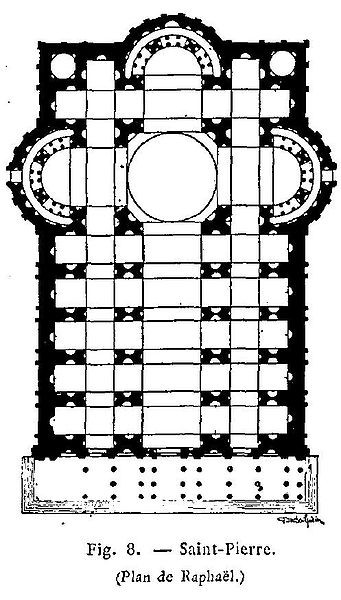
Lastly, the practice of transformation can be a very helpful design too. Transformation takes a design and makes changes such that it still retains its original identity afterward. We can see this when comparing Bramante's and Raphael's plans for St. Peter's Basilica in Rome.

 Notice the elongation of the basic basilica plan in Raphael's version versus Bramante's more centralized and compact composition below.

An axis, for example, is a line (visible or implied) that divides symmetrically or in a balanced fashion. Put another way, it's the central point or line around which everything collects, gathers, organizes or rotates.

 |
| Picture taken from Wikimedia Commons. |
Symmetry then, to follow up, is a balanced arrangement around a central point or axis. This definition tends to go hand-in-hand with an axis, but a building or space could have more than one axis and with no symmetry, whereas symmetry demands an axis to revolve around.

 |
| Images Copyrighted by Historylink101.com & found at Egyptian Picture Gallery. |
But perhaps your arrangement will have asymmetrical balance, instead. One way to achieve this is through hierarchy, heightening the importance or distinguishment of a form or space through increased scale, articulation, shape, or other design principle.

 |
| Taken from Wikimedia Commons. |
Rhythm is a recurring pattern or motif - it repeats or alternates in some manner, such as through color, shape, or positioning.

 |
| Image credit: Architectural Digest. http://www.architecturaldigest.com/resources/notebook/2008/06/oscar_slideshow |
Often we see datum organizing our designs, a line, plane or volume to which other elements relate. An axis line would be a pertinent example.

 |
| Taken from Wikimedia Commons. |
Lastly, the practice of transformation can be a very helpful design too. Transformation takes a design and makes changes such that it still retains its original identity afterward. We can see this when comparing Bramante's and Raphael's plans for St. Peter's Basilica in Rome.


 |
| Taken from Wikimedia Commons. |
Subscribe to:
Posts (Atom)